Anacostia, DC: The River Crossing Most Visitors Never Make
East of the Anacostia River sits one of DC's oldest neighborhoods and some of its most consequential Black history — a hilltop home Frederick Douglass bought to break the very covenant meant to keep him out, a freedmen's community whose fight against school segregation helped shape Brown v. Board of Education, and a downtown-adjacent stretch of the city most visitors never cross the bridge to see. Here's what actually happened, and what's worth your time there now.
Most DC guides either skip Anacostia entirely or reduce it to one line about Frederick Douglass. Both undersell it. This is one of the only places in the city where you can trace a straight line from a whites-only 1854 land covenant to the man who broke it to a legal fight that reshaped American schools — all within a ten-minute walk. Go during the day, go for Cedar Hill and the museum, and don't skip the walk up MLK Avenue for the murals.
Uniontown: Built to Keep Black and Irish Families Out
In 1854, developers John Dobler, John Fox, and John W. Van Hook bought roughly 240 acres of farmland across the river from the Navy Yard and subdivided it into affordable lots for the city's working class — many of them Navy Yard laborers who couldn't afford to live near downtown. They called it Uniontown, and the original deeds carried a restrictive covenant barring the sale, rental, or lease of any lot to anyone of African or Irish descent.
By 1886, so many "Uniontowns" had sprung up around the country after the Civil War that Congress voted to rename this one — choosing Anacostia, after the Nacotchtank people who had lived along the river long before any subdivision existed. The irony of what happened next is the whole story: within a generation, the neighborhood built to exclude Black families became one of the most significant Black communities in the country.
Barry Farm and a Case That Reshaped American Schools
A few blocks from Uniontown's original covenant lots, the federal Freedmen's Bureau began settling formerly enslaved families on land known as Barry Farm in 1867, the same year Black men in DC won the right to vote. Families built their own homes, churches, and schools, and the community grew into a base for Black political organizing that outlasted its own name. Frederick Douglass's three sons — Lewis, Frederick Jr., and Charles — all settled in the greater Anacostia area after moving to Washington in the late 1860s, and Charles lived out his life on what's now Douglass's own street.
Barry Farm's most consequential legacy is legal: the community's decades-long fight against school segregation helped build the record behind Bolling v. Sharpe, the DC companion case decided alongside Brown v. Board of Education in 1954. In 1941, the federal government used eminent domain to take 34 acres of the original community and build the Barry Farm Dwellings public housing complex. That complex was demolished in a contested redevelopment that displaced longtime residents in the 2010s and 2020s — a fight documented in the 2022 film Barry Farm, and still a live wound for a lot of people east of the river.
Frederick Douglass's Cedar Hill
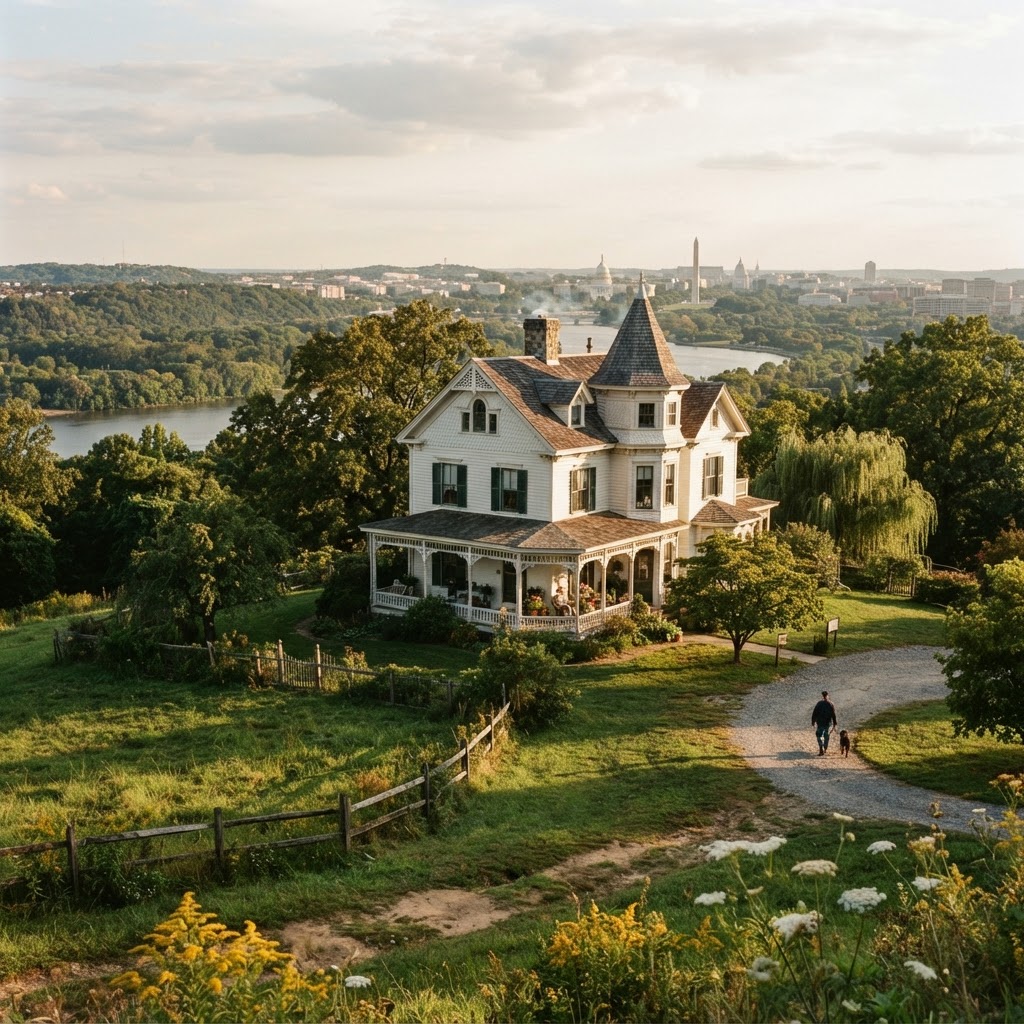
Frederick Douglass bought a house on a hilltop above the neighborhood in 1877 and named it Cedar Hill — a direct, deliberate break of the very covenant Uniontown's founders had written to keep men like him out. He lived there until his death in 1895, writing, hosting abolitionist allies, and serving as the first Black U.S. Marshal for the District. The Frederick Douglass National Historic Site (1411 W Street SE) preserves the home today, and it's one of DC's best free stops that most tourists skip entirely.
The only way inside the house is a National Park Service ranger-guided tour — offered Tuesday through Saturday, with free timed tickets available online and strongly recommended in advance since space on each tour is limited. The visitor center and grounds, with sweeping views back across the river toward the Capitol, are open the same days without a reservation.
1968, Decades of Disinvestment, and What's Changing Now
Like much of Black Washington, Anacostia's commercial corridor was devastated by the unrest following Dr. Martin Luther King Jr.'s assassination in April 1968, and it went decades without the kind of reinvestment that reached U Street or Shaw. That's shifting, unevenly and not without controversy. The St. Elizabeths East campus on the neighborhood's south end is now home to CareFirst Arena (renamed from Entertainment and Sports Arena in a 2025 sponsorship deal), which hosts the WNBA's Washington Mystics, the NBA G League's Capital City Go-Go, and a Washington Wizards practice facility.
A few blocks north, the long-planned 11th Street Bridge Park — an elevated public park built on the old bridge pilings connecting Anacostia to Navy Yard, with an amphitheater, environmental education center, and kayak launches — is fully funded and finally moving into construction after 13 years of planning, with an opening currently projected for 2027 or 2028. Whether this new investment reaches the people whose families were displaced from Barry Farm, or repeats the same pattern, is an open and genuinely contested question in the neighborhood right now — not something a tourism guide can resolve, but worth knowing before you visit.
What's Actually Worth Doing There Now
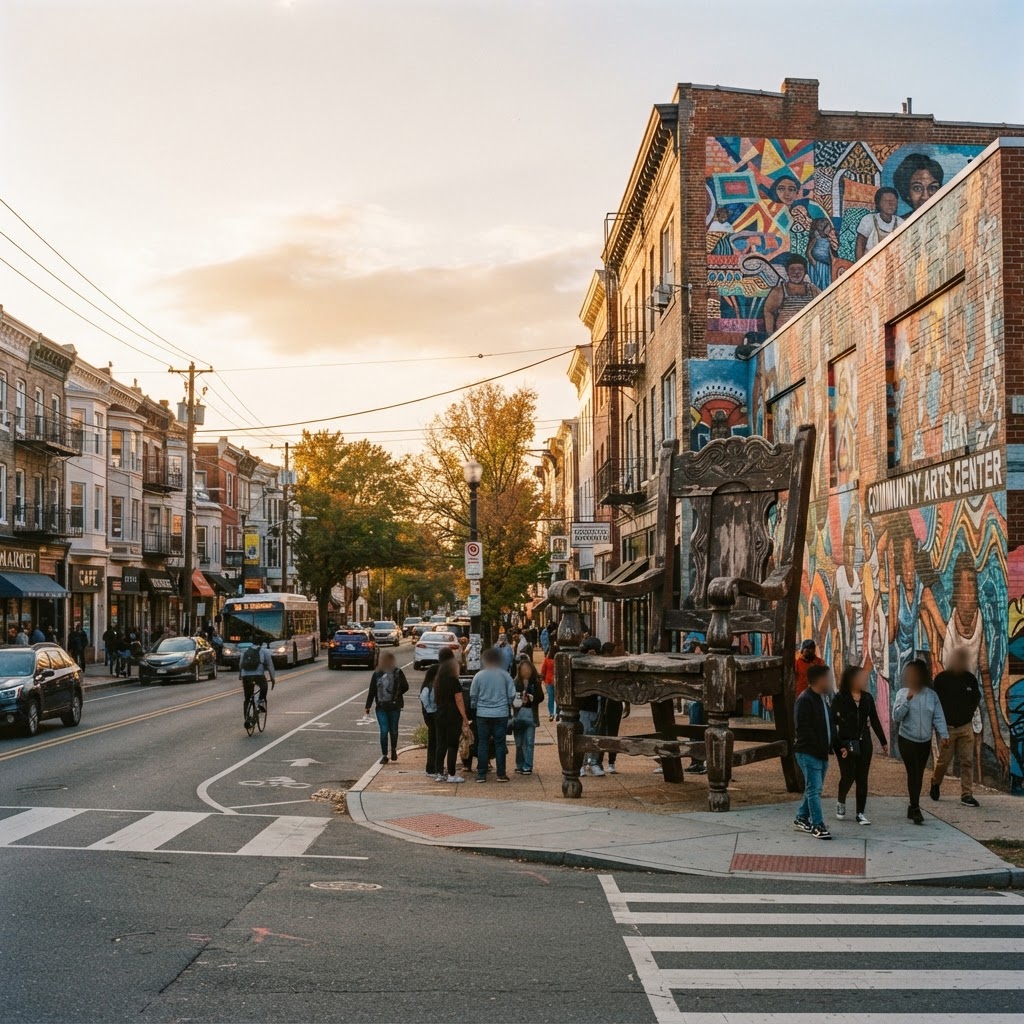
The Big Chair, a 19.5-foot wooden armchair built as a 1950s furniture-store advertisement, still overlooks the corner of Martin Luther King Jr. Avenue and V Street SE and remains the neighborhood's most-photographed landmark. From there, a self-guided walk up MLK Avenue and Good Hope Road SE passes a dense run of murals covering Black history, social justice, and neighborhood pride — genuinely some of the best public art in the city, and almost entirely undocumented by mainstream DC guides.
The Smithsonian's Anacostia Community Museum (1901 Fort Place SE) opened in 1967 as the Smithsonian's first community-based museum and still runs rotating exhibits on Black life east of the river — free, like every Smithsonian. Honfleur Gallery on Good Hope Road SE keeps a regular exhibition calendar worth checking before you go. One heads-up: the Anacostia Arts Center, previously the neighborhood's main indoor arts hub, closed for a full renovation in early 2026 and isn't expected to reopen until 2027 — don't plan a visit around it until then. For food, Busboys and Poets anchors MLK Avenue with an all-day menu and a room named for former mayor Marion Barry, DCity Smokehouse handles barbecue, and King's Cafe is a solid coffee stop. The Anacostia Riverwalk Trail runs along the water through Anacostia Park if you want river views without a car.
Where It Is and How to Get There
The historic core sits roughly between Martin Luther King Jr. Avenue on the west, Good Hope Road on the north, and Fendall Street near the Douglass home on the east — small enough to walk in an afternoon. The Anacostia Metro station (Green Line) sits close to Cedar Hill and the Big Chair; Congress Heights station, also Green Line, is the closer stop for St. Elizabeths East and CareFirst Arena. See our Neighborhoods overview for how a visit here fits alongside DC's more typical stops.
Compare Hotel Prices Near DC's Sights
Anacostia is a short Metro ride from downtown — see current rates before you book.
See Anacostia's History With a Guide
A guided African American history tour is a good way to connect Anacostia's story to the rest of Black Washington.

African American History Tour with Museum of African American History Ticket
KB Tours is a one of a kind African American Heritage tour operator in Washington DC that takes visitors to explore the historic African American neighborhoods in all four quadrants of the city, often going off the beaten path. With knowledgeable guides who are passionate about sharing interesting facts and captivating stories of Washington DC's black history, KB Tours prides itself on providing an engaging and entertaining tour experience. Visitors will have the opportunity to stop and visit iconic landmarks and monuments in the city, including the Lincoln Memorial, the Martin Luther King Jr. Memorial, the Capitol, the White House exterior, and tour the Frederick Douglass when opened. KB Tours' guides are committed to keeping visitors of all ages engaged throughout the tour, encouraging young children to participate in the tour activities. The tour includes a ticket the Museum of African American History and Culture. You must take the tour to join us for entrance to museum.
Historical details are drawn from the National Park Service's Frederick Douglass National Historic Site materials, the Smithsonian Anacostia Community Museum, the DC Policy Center's history of Barry Farm, DC Historic Sites/DC Preservation League records, and reporting on the 11th Street Bridge Park and Anacostia Arts Center renovation timelines.
Frequently Asked Questions
Keep Exploring
Chocolate City: DC's Black History & Culture Guide
The wider story Anacostia's history fits into.
Beat Ya Feet: DC's Street Dance Culture
Born in Anacostia's Barry Farm alongside go-go music.
National Museum of African American History and Culture
Pair a downtown stop with the story told on this side of the river.
Neighborhoods & Where to Stay
How Anacostia compares to DC's other home-base options.
Shaw: Built From Scratch
Another DC neighborhood shaped by the same history.