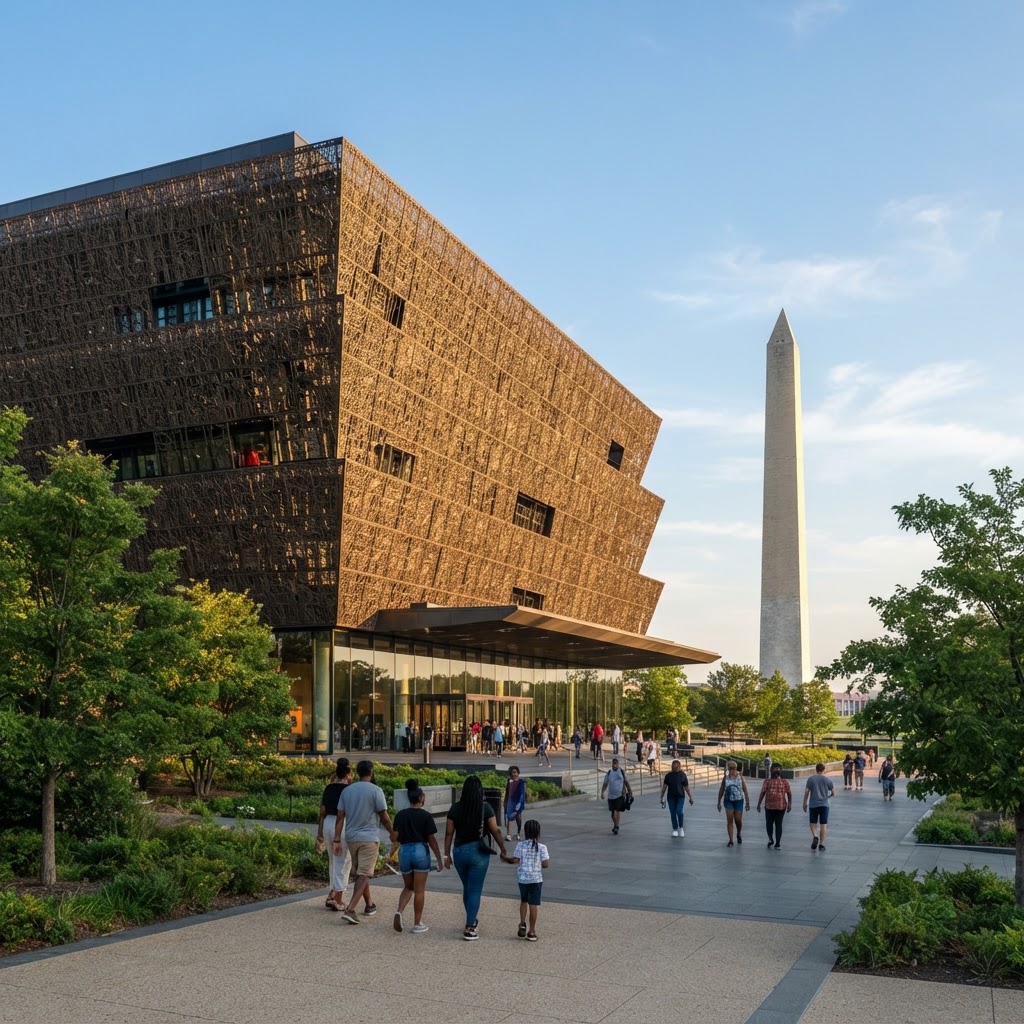
National Museum of African American History and Culture: A Local's Guide
This is the Smithsonian that punishes winging it. You need a timed pass, the building is far bigger than it looks from Constitution Avenue, and the strongest way through it starts below ground — not on the culture floor where the music and sports artifacts tempt you first.
Do not schedule this between two other museums like it is another quick Mall stop. Give NMAAHC a half-day, start with the history galleries, and use Sweet Home Café as the reset before heading upstairs. The museum lands differently when you stop treating it like a checklist.
The Timed Pass Is Free — and It Is Not Optional
NMAAHC is one of the few Smithsonian museums where you cannot simply walk in whenever you feel like it. Every visitor, including babies, needs a free timed-entry pass. The museum releases advance passes 30 days ahead on a rolling basis, and a limited batch of same-day passes goes online by 8:15 a.m. Eastern. Reserve through the museum's official Plan Your Visit page, not a reseller — the passes are free and cannot be sold or transferred.
Weekend and holiday slots disappear first. If the date you want is gone, try the same-day release right at 8:15 rather than refreshing randomly all afternoon. Your pass does not put a time limit on the visit; once you are inside, you can stay until closing. The museum currently allows entry after the printed time until 4:00 p.m. when capacity permits, but building your plan around that grace period is asking for trouble.
Start Underground, Then Work Your Way Up
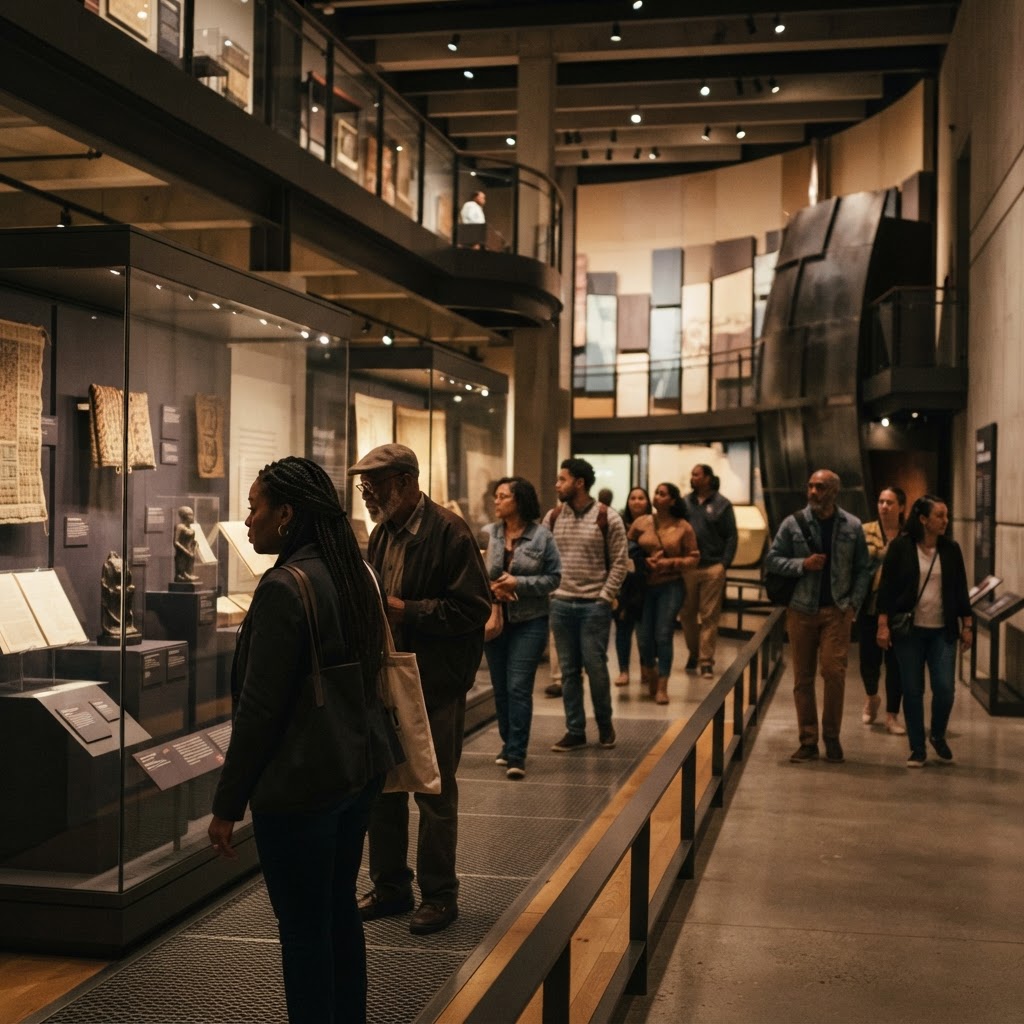
The cleanest route is to begin in the History Galleries below ground: Slavery and Freedom on Concourse 3, Defending Freedom, Defining Freedom on Concourse 2, then A Changing America on Concourse 1. That sequence carries the story from the transatlantic slave trade through emancipation, segregation, the modern Civil Rights Movement, and the continuing fight over citizenship and equality. Do not sprint through it just to say you reached the upper floors.
This part of the museum is dense and emotionally demanding. Give it room. If your group only has ninety minutes, choose a section instead of trying to conquer the entire building. A proper first visit is a half-day, and even that means making choices across roughly 85,000 square feet of exhibition space.
The Upper Floors Are Not an Afterthought
After the history sequence, the Community Galleries on Level 3 shift the focus to how Black communities built institutions, served in the military, shaped sports, and made places for themselves across the country. Level 4 is the culture payoff: Musical Crossroads traces the reach of African American music from spirituals and blues through jazz, rock, R&B, and hip-hop; Cultural Expressions looks at food, language, style, and other forms of identity; Taking the Stage covers performance and social change.
If DC music is the thread you care about most, pair Musical Crossroads with our Go-Go Music guide. The museum provides the national frame; the guide explains why percussion, call-and-response, and the live groove still matter specifically in Washington.
Sweet Home Café Is Part of the Visit
Sweet Home Café is not generic museum food dressed up with a better name. Its stations use regional African American food traditions to carry the same history-and-culture story into the meal. It is a smart break between the lower history floors and the upper culture galleries, especially if you have been standing and reading for two hours.
Hours and menus change, so check the museum's official café page before counting on a particular dish. Seating is first-come, first-served, outside food is not allowed, and the lunch rush can be real. A separate Dine & Shop pass exists for people who only want the café and museum store; it is not a shortcut into the exhibition galleries.
The Building Deserves a Slow Look Too
The three-tier bronze-colored exterior is called the Corona. Its stacked form draws from the work of Yoruba sculptor Olowe of Ise, while the open-weave metal panels honor the craftsmanship of enslaved and free African American metalworkers in South Carolina and Louisiana. The panels also filter light and heat, so the design is doing practical work instead of serving as a decorative wrapper.
Step back toward the Washington Monument before or after your visit. The Corona's upward angles were designed to echo the angle of the monument's capstone, a deliberate conversation between the Mall's newest major museum and one of its oldest symbols. The museum opened on September 24, 2016; the building itself makes clear that this history belongs at the center of the National Mall, not off to the side.
Getting There Without Making It Hard
The museum is at 1400 Constitution Avenue NW, between the Washington Monument and the National Museum of American History. Federal Triangle and Smithsonian are the closest Metro stations. There is no Smithsonian public parking on the Mall, so driving usually turns a museum visit into a hunt for an expensive garage. Use our Getting Around DC guide or interactive Metro map and arrive with less drama.
Timed passes are scanned at the Madison Drive and Constitution Avenue entrances. Both are accessible; Madison Drive has a vehicle drop-off area. Security screening is required, so carrying less gets you inside faster. When you finish, the Monuments and Memorials guide is the natural next move — the Washington Monument is right outside, and the World War II and Lincoln memorials continue west along the Mall.
Go Deeper With a Guided Heritage Tour
If a single museum visit leaves you wanting the fuller city story, a guided African American history tour extends the same themes out into U Street, Anacostia, and other DC neighborhoods.

African American History Tour with Museum of African American History Ticket
KB Tours is a one of a kind African American Heritage tour operator in Washington DC that takes visitors to explore the historic African American neighborhoods in all four quadrants of the city, often going off the beaten path. With knowledgeable guides who are passionate about sharing interesting facts and captivating stories of Washington DC's black history, KB Tours prides itself on providing an engaging and entertaining tour experience. Visitors will have the opportunity to stop and visit iconic landmarks and monuments in the city, including the Lincoln Memorial, the Martin Luther King Jr. Memorial, the Capitol, the White House exterior, and tour the Frederick Douglass when opened. KB Tours' guides are committed to keeping visitors of all ages engaged throughout the tour, encouraging young children to participate in the tour activities. The tour includes a ticket the Museum of African American History and Culture. You must take the tour to join us for entrance to museum.
Frequently Asked Questions
Keep Exploring
Smithsonian Museums Guide
Compare NMAAHC with the rest of the museums on and near the Mall.
Go-Go Music: DC's Official Sound
The local story behind one of the culture floor's most Washington-specific threads.
Getting Around DC
Metro, walking, and the practical case against driving to the Mall.
Monuments & Memorials Guide
What to see immediately after the museum without crossing the city.