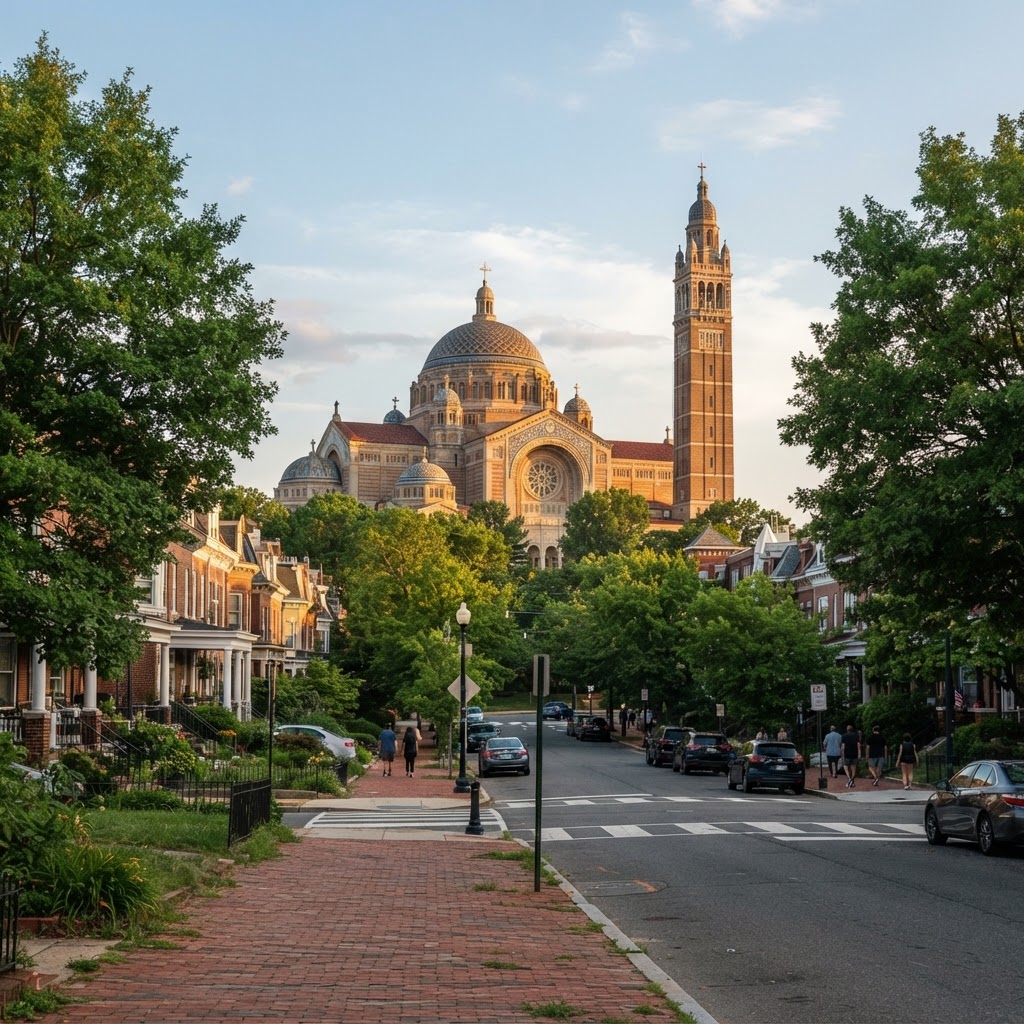
Brookland: DC's Little Rome
Fifteen minutes up the Red Line from Union Station is a Northeast neighborhood with the largest Catholic church in America, a Byzantine monastery with replica catacombs and forty acres of gardens, and an artists' walk — and almost no tourists.
The Basilica gets the visitors; the Franciscan Monastery gets almost none, and it's the one I send people to. Free tour, replica catacombs under the church, and gardens in May that would be mobbed if they were anywhere near the Mall. Go on a weekday morning and you'll have the place to yourself.
Why They Call It Little Rome
Brookland picked up the nickname honestly. Catholic University of America has been here since 1887, and the religious orders followed it — seminaries, houses of study, convents, and monasteries clustered around the campus until Northeast DC had accumulated dozens of Catholic institutions in a couple of square miles. Nowhere else in the country looks quite like this, and most visitors to Washington never see any of it.
That's the thing worth understanding before you come: Brookland isn't a tourist neighborhood that happens to have churches. It's a residential neighborhood — detached houses, porches, actual front yards, which is already unusual for DC — with two genuinely world-class religious sites sitting in the middle of it. You come for those, and you stay because the walk between them is pleasant in a way the Mall never is.
The Basilica of the National Shrine of the Immaculate Conception
This is the largest Roman Catholic church in the United States and among the ten largest churches in the world. At roughly 329 feet, its campanile is the tallest habitable structure in Washington — a fact that surprises people who assume the Washington Monument holds that title, which it doesn't, because you can't live in an obelisk.
What makes the Basilica worth the trip isn't the size, though. It's the mosaic work. The building holds more than eighty chapels and oratories, most of them donated by American Catholic communities honoring the Virgin Mary as their own countries and cultures depict her — so you walk from one national tradition to the next in a single afternoon. The Trinity Dome and the enormous Christ in Majesty mosaic in the north apse are the images people remember, and neither photographs the way they look in person.
Guided and self-guided tours are both available, and admission is free. It's an active church, so tour availability works around the Mass schedule — check the Basilica's own site for current tour times and any liturgical closures before you go, and dress like you're entering a place of worship, because you are.
The Franciscan Monastery of the Holy Land in America
Ten minutes' walk from the Basilica and almost nobody goes. The Franciscan Monastery is a Byzantine-style complex built as the American home base for the friars who maintain the holy sites in the Middle East, and it's built around a specific idea: replicas of shrines from the Holy Land, so American Catholics who couldn't make the pilgrimage could see them here.
Underneath the church there's a reproduction of the Roman catacombs, which is exactly as strange and memorable as it sounds. Free guided tours of the church and catacombs run most days, typically several times a morning and afternoon with a reduced Sunday schedule — donations appreciated, and times shift, so confirm on the monastery's site.
The grounds are the underrated part. There are more than forty acres of gardens with well over a thousand plant varieties, including a substantial rose collection, and they're open daily and free to walk. In May they're one of the prettiest places in Washington and there will be maybe a dozen people there. The monastery also runs an annual plant and herb sale in spring that draws serious gardeners from across the region.
Monroe Street Market and the Arts Walk
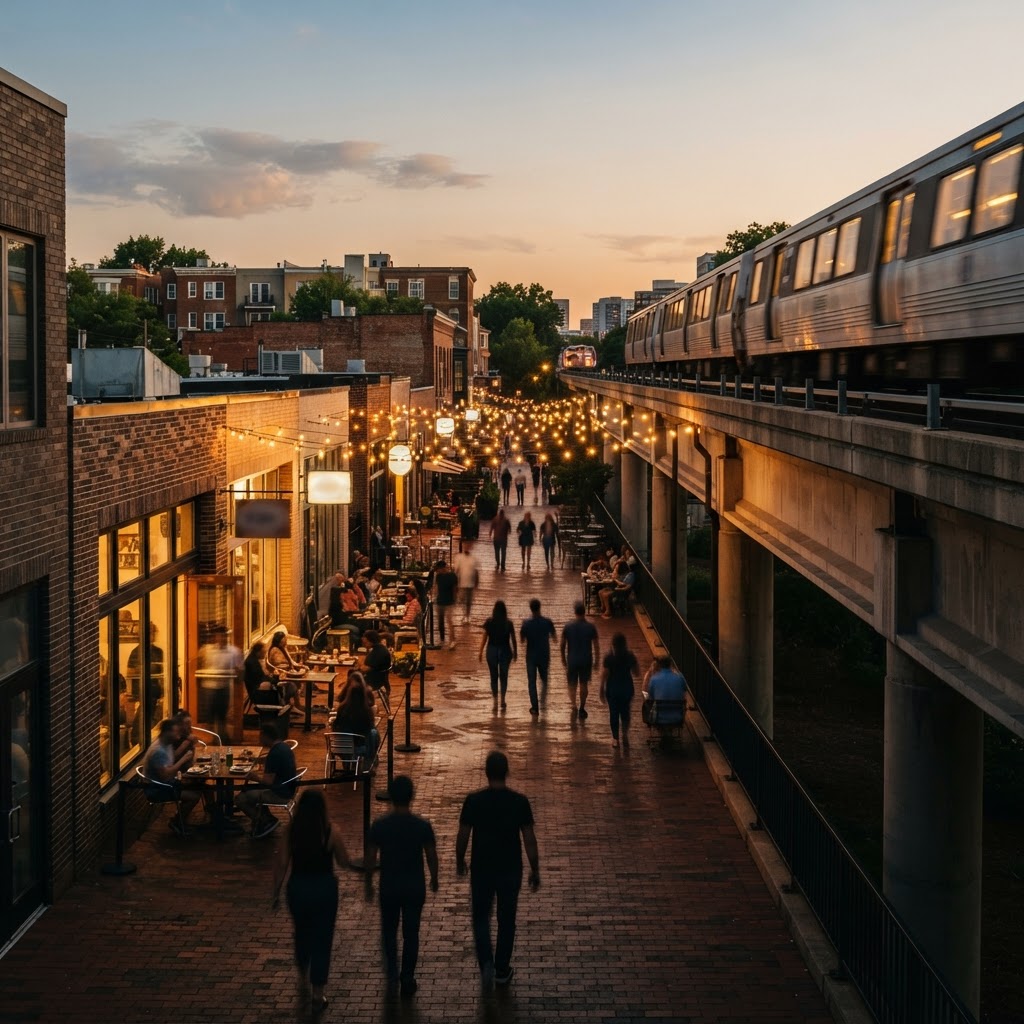
Right at the Metro station, Monroe Street Market is the newer, denser side of Brookland — apartments over ground-floor restaurants, built out in the 2010s on land that used to belong to the university. Running through it is the Arts Walk, a pedestrian lane lined with small artist studios in converted garage-style spaces, plus a seasonal Saturday farmers market.
Worth being clear about the history here, because the marketing usually isn't: Brookland's arts scene long predates the development. Dance Place, the performance venue and school a few blocks away, has been anchoring it for decades and still runs a full presenting season. The Arts Walk added retail-facing studios to a neighborhood that already had artists in it.
Studio hours are irregular — these are working artists, not a mall — so the walk is best on a weekend afternoon when more doors are open. Brookland Pint on the Arts Walk is the reliable anchor for a beer and a meal, with a big local draft list and a mural of the monuments and the Shrine that tells you exactly where you are.
Eating in Brookland
Brookland's food scene is small and good rather than large and trendy, which is a fair trade. Menomale turns out Neapolitan pizza that gets named among the city's best by people who argue about pizza for a living. Primrose in nearby Woodridge does French cooking with a Southern accent and a wine list that outperforms its ZIP code. Brookland's Finest is the neighborhood bar-and-restaurant everyone defaults to, and it earns it.
The usual caveat applies harder here than downtown: these are independent neighborhood restaurants with small kitchens. Hours change, and some close on days you wouldn't expect. Check before you make the trip out, and reserve if you're coming for dinner.
Getting Here, and How to Spend Half a Day
Brookland-CUA sits on the Red Line, about fifteen minutes from Union Station and twenty from Gallery Place — this is one of the easiest 'off the tourist track' trips in the city precisely because you don't leave the rail system to make it. The station puts you directly at Monroe Street Market, with the Basilica a short walk west across the CUA campus.
If you're on a bike, the Metropolitan Branch Trail runs right past the neighborhood on a protected path connecting Union Station and NoMa up toward Silver Spring. It's the best cycling approach to Brookland and one of the few DC trails where you're genuinely separated from traffic the whole way.
A good half day: Red Line to Brookland-CUA, walk the Arts Walk while the studios open up, cut across campus to the Basilica and spend an hour there, walk northeast to the Franciscan Monastery for the catacombs tour and the gardens, then back down 12th Street NE for a late lunch before you catch the train. That's four to five hours, all on foot, and it will not feel like the DC you saw on the Mall.
Should You Stay Out Here?
Probably not, and that's not a knock on the neighborhood. Brookland has very little conventional hotel inventory — it's a residential area, not a lodging district — so staying here means a short-term rental and a Red Line commute to everything you came to Washington for. For a first trip, base yourself closer in and treat Brookland as a half-day excursion.
Where it does make sense: if you're visiting someone at Catholic University, coming for a specific liturgical event at the Shrine, or you've been to DC enough times that a quieter, more residential base sounds better than another downtown lobby. In that case the Red Line corridor between Union Station and Silver Spring is the stretch to search, since it keeps you on the same line without paying central-DC rates.
Frequently Asked Questions
Keep Exploring
DC Neighborhoods Guide
How Brookland compares to the rest of the city's neighborhoods.
Petworth
The other quiet residential neighborhood worth a Metro ride.
Interactive Metro Map
Live Red Line times for the ride out to Brookland-CUA.
Free Things to Do in DC
The Basilica, the monastery, and its gardens all cost nothing.
DC for History Buffs
More of the city's layered, non-obvious history beyond the Mall.